
Antennas for Space
Space-qualified antennas engineered for UHF through K-band, delivering reliable performance for telemetry, GPS, data transmission, and flight termination.
Our range of space application antennas covers UHF, L, S, C, X and K-Band, supporting telemetry, GPS, data, and flight termination.
Our low gain antennas typically feature hemispheric or isoflux radiation patterns with linear or circular polarization. For medium gain applications or where beam shaping is required, antenna arrays are the solution.
GPS single elements and arrays, along with low gain antennas and arrays for S, C, and X-Band, have been successfully flown in space, demonstrating their reliability and performance.
Explore our high-performance space antennas, designed to meet your mission’s unique requirements. Contact us to discuss how we can support your next space mission.
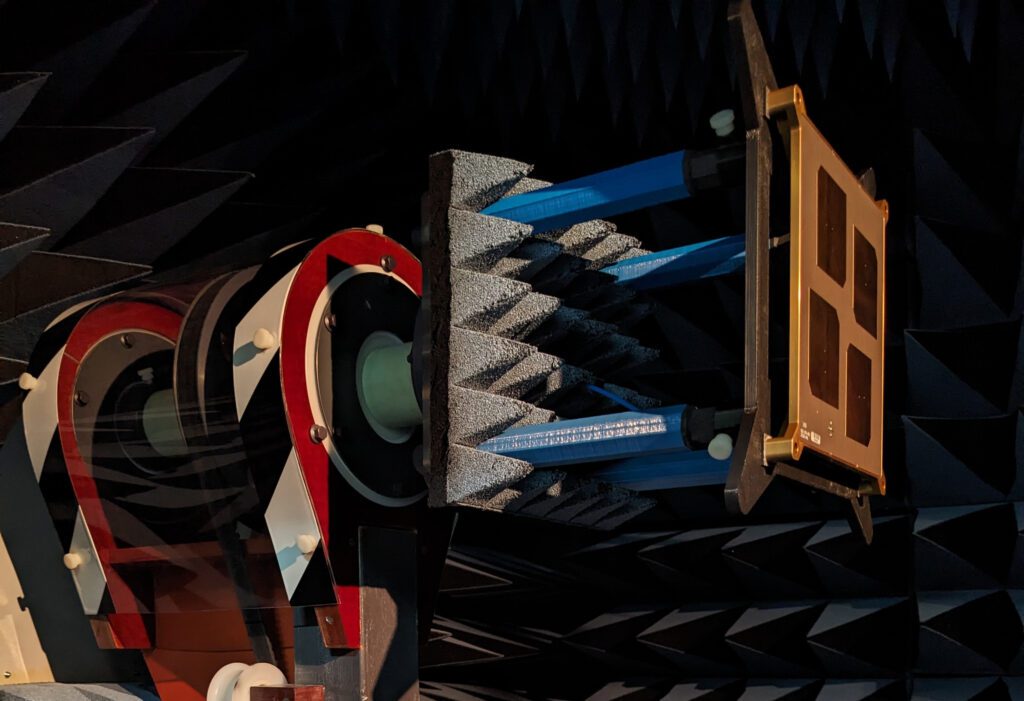
GPS L1 4 Element Array
This space-qualified 2×2 GPS antenna array is optimized for GPS L1 and provides right-hand circular polarization (RHCP) for high-precision satellite navigation and timing applications. Its robust design makes it ideal for deployment in demanding orbital environments.
Optional support for GPS L2 is available via dedicated feed networks, enabling enhanced signal performance across both bands without requiring diplexers. Dual linear polarization is also available upon request for missions requiring alternative signal configurations.
The array features stripline-based feed networks for improved shielding and low noise pickup. Radiating elements are grounded to prevent static electricity buildup, ensuring safe and stable operation in space.
C and X-Band Isoflux Antennas
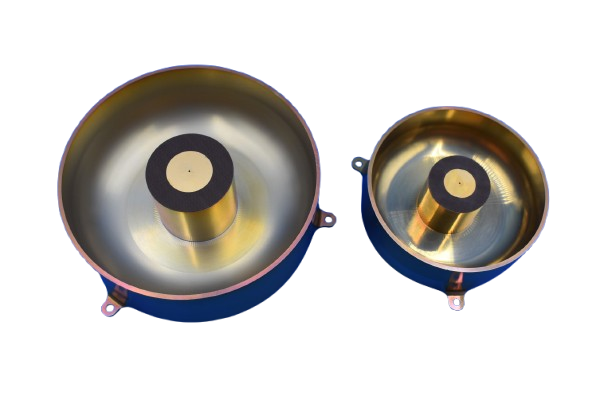
An isoflux antenna is designed to create a uniform field strength across the satellite’s coverage area.
This uniformity compensates for the natural decrease in signal strength that occurs as the distance from the satellite to the edges of the coverage area increases compared to the distance to the sub-satellite point.
In practical terms, the isoflux antenna ensures that the signal strength remains consistent across the entire coverage area, overcoming the typical signal drop-off at the edges.
This characteristic is particularly important for ensuring reliable communication and data transmission across the entire footprint of the satellite.
Hemispheric Coverage
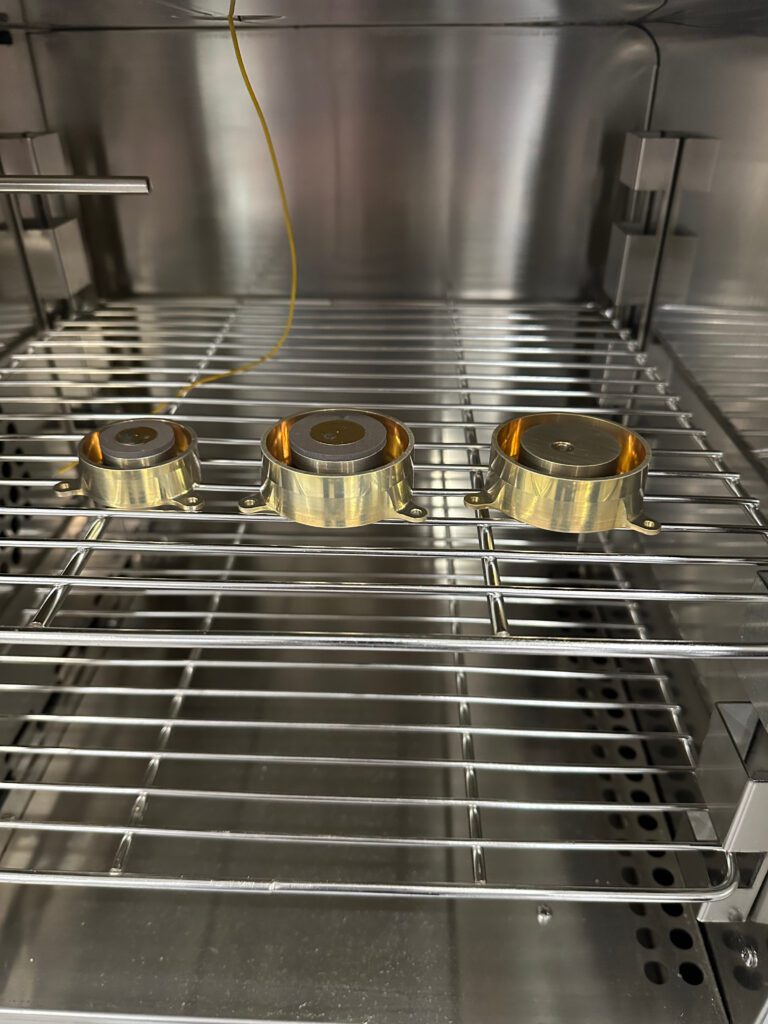
Mounting a patch antenna on a cavity provides additional design flexibility. This configuration enhances directivity, improves the axial ratio -particularly at low elevations- and increases isolation from adjacent antennas.
The improved isolation is especially valuable for full duplex operation.
By selecting the appropriate modes for both the patch and the cavity, the radiation pattern can be precisely controlled
In these designs, the antenna produces a clean, hemispheric pattern with excellent axial ratios extending down to the horizon.
Cavity Backed Patch Antennas
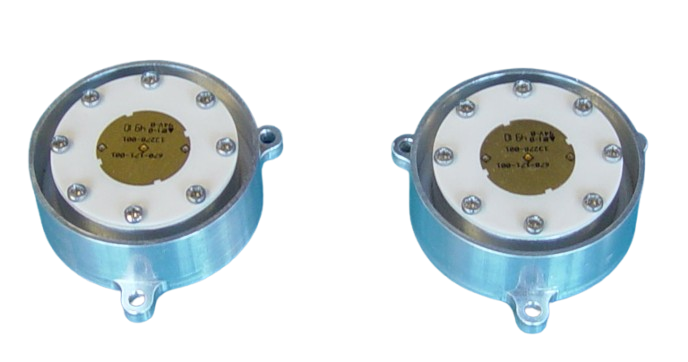
Another typical example of a cavity-mounted patch is where the patch operates in TM21 mode and the choke operates in its fundamental mode.
This specific design is optimized for maximum gain at 43° elevation.
These transmit and receive antennas were designed for use with our coherent X-Band transponder for a Mars lander. That elevation is optimal for communication with Mars.
GPS L1/L2 Antenna Arrays
Available in dual linear and RHCP configurations, this passive GPS array delivers hemispheric coverage with excellent axial ratio.
Configurations with two or three elements are available, supporting flexible integration into different platforms.
Suitable for GPS L1/L2 navigation, timing, and tracking in space applications.


L and S-Band Planar Isoflux Antennas
For higher frequencies, such as C and X-Band, cavity-backed antennas are often used to achieve the desired isoflux radiation pattern.
However, at lower frequencies like L and S-Band, the larger size of the required cavities makes this approach impractical.
Instead, planar solutions have been successfully developed to provide the necessary coverage and maintain signal uniformity at these lower frequencies.
Single Frequency Patch Antennas
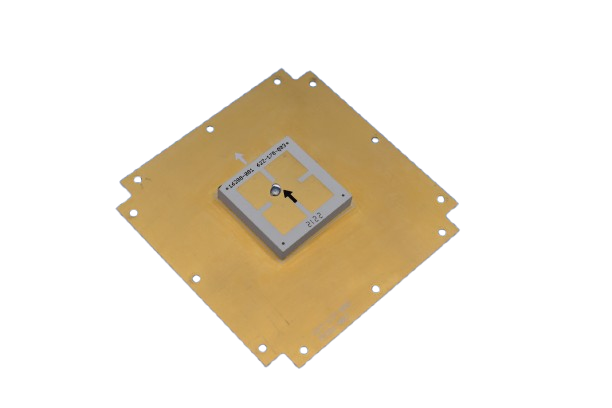
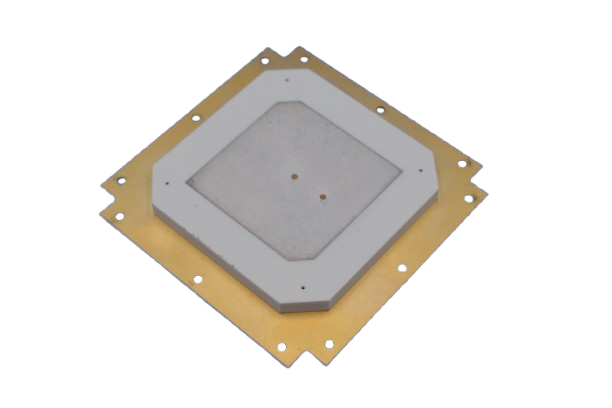
Our range of patch antennas is designed to meet a variety of needs across multiple frequency bands, including GPS L1, L, S, C, and X-Band.
These versatile antennas can be customized with either linear or circular polarization to suit specific application requirements.
Typically, patch antennas deliver a gain of 3 to 5 dBi.
Patch antennas are known for their high radiation efficiency. They typically offer bandwidths in the 3% range, with techniques available to increase bandwidth sometimes at the cost of some efficiency.
Whether you need an antenna for navigation, communication, or data transmission, patch antennas provide a dependable solution that can be tailored to your specific frequency band and polarization needs.
Multi Frequency Patch Antennas
Patch antennas can be vertically stacked to create a wider band solution or to cover multiple frequency bands.
A typical example of a dual-band solution is a Patch antenna designed to cover both GPS L1 and L2 frequencies.
An example of a three-frequency solution is one that includes GPS L1, L2, and 2.2 GHz.
Another example is a stack of two patches designed to cover the S-Band segment, spanning from 1.9 to 2.2 GHz.
These stacked configurations allow for greater flexibility and adaptability in various applications